If your local Back Yard Burgers closed recently, you’re part of a massive collapse. The chain dropped from 180+ locations to just seven by 2024 after two bankruptcies and decades of corporate mismanagement. Private equity takeovers slashed quality—smaller patties, eliminated seasoned fries—while franchisees resisted cost-cutting moves. The 2023 bankruptcy hit hardest, shuttering hundreds of stores nationwide. Now under new ownership, only Memphis, Florida, Illinois, and North Carolina locations remain operational. Understanding how we got here reveals what went wrong.
From 180+ Locations to Seven: The Back Yard Burgers Collapse
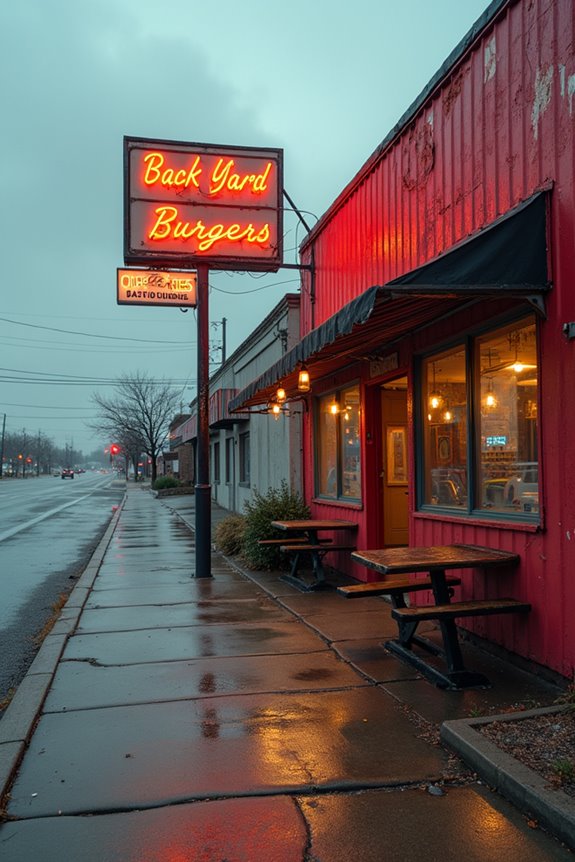
Anyone who ate at Back Yard Burgers in the early 2000s might’ve noticed something troubling lately—the restaurants kept disappearing. The chain once operated over 180 locations across the country. Today, only seven remain. This dramatic collapse happened because of serious financial troubles. Back Yard Burgers filed for bankruptcy twice: first in 2012 and again in 2023. The second bankruptcy hit harder. In 2023 alone, the company closed many stores, especially in Mississippi and Tennessee areas where the chain had strong roots. When Back Yard Burgers emerged from bankruptcy in late 2024, it was a fraction of its former self. Private equity ownership from 2017 onward led to repeated closures and restructuring. The chain you remembered from your childhood basically vanished.
How Going Private in 2007 Cut Costs and Quality
The 2007 privatization of Back Yard Burgers marked a turning point that fundamentally changed how the chain operated. When private equity investors led by Lattie Michael took control, they shifted focus from corporate administration to in-store cost-cutting. The results were immediate and noticeable.
First, burger patty sizes shrank. Second, the chain eliminated its signature seasoned fries. These weren’t small tweaks—customers felt the difference in their meals. Corporate executives began spending more time in stores, but not to improve quality. Instead, they implemented privatization strategies designed to reduce expenses and boost profits.
The approach backfired. While cost-cutting measures helped short-term margins, they damaged what made Back Yard Burgers special. Quality declined, and customers took notice. This sacrifice of product excellence for profit margins set the stage for the store closures that followed.
The 2012 Bankruptcy: Inside the Collapse
By 2012, Back Yard Burgers’ financial troubles caught up with the company, and it filed for Chapter 11 bankruptcy carrying roughly $62 million in debt while holding only about $13 million in assets. The situation was serious—I’ll be honest about that. The bankruptcy forced difficult decisions, including closing 22 stores as part of the restructuring effort that year. It wasn’t a quick resolution either. The company needed new financial backing to survive. Pharos Capital stepped in with financing in January 2013, which allowed Back Yard Burgers to emerge from bankruptcy. Leadership also changed that same year when a new CEO took over, bringing fresh direction to guide the post-bankruptcy recovery. These moves showed the franchise was fighting to rebuild.
Why the 2013 Rescue Deal Fell Apart
While Pharos Capital brought fresh financing and installed new leadership to restore Back Yard Burgers’ 1/3-pound patties and seasoned fries, the rescue stumbled because strategic choices didn’t align with what customers actually wanted in a changing market. Franchisees like Resolute Brands resisted corporate control decisions, creating tension between maintaining product quality and making the operational changes stores needed to survive. The real problem: you can’t fix a chain’s closures through better burgers alone when the underlying business model—especially after losing the Yum! Brands co-branding deal—couldn’t generate enough growth to support the remaining locations.
Pharos Capital’s Strategic Missteps
When Pharos Capital Group stepped in with financing in January 2013, they brought a new CEO (Doug McDougall) and a clear plan: get Back Yard Burgers profitable again by reintroducing signature products like 1/3-pound burgers and seasoned fries, then capitalize on momentum from their Resolute Brands portfolio. Here’s what went wrong: Pharos underestimated how fragmented the franchise network had become. They focused on product revival while ignoring deeper operational problems. The private-equity approach—streamline costs, cut underperforming locations—clashed with franchise-owner interests. Stores kept closing anyway. Profitability never materialized. Strategic misalignment between corporate restructuring goals and franchisee realities created constant friction. By the time another Chapter 11 filing came in 2023, it was clear: no rescue deal could have addressed a system broken at its foundation.
Product Recovery Versus Market Headwinds
The product strategy looked solid on paper: bring back the 1/3-pound Black Angus beef burgers, reintroduce the seasoned fries, remind customers why they’d loved Back Yard Burgers in the first place. Pharos Capital made smart moves in 2013, focusing on core offerings that built the brand’s reputation. Here’s the thing though—better burgers couldn’t fix everything. Back Yard Burgers faced serious market headwinds that product alone couldn’t overcome. Franchise relationships were strained, competition intensified, and customer traffic didn’t bounce back as hoped. The 2013 rescue showed us that reviving menu items matters, but it’s only part of the equation. When broader economic pressures and structural challenges mount, even quality products struggle. Eventually, bankruptcy returned, proving that product recovery and market forces tell different stories.
Franchise Resistance And Corporate Control
By 2013, Pharos Capital’s rescue plan had a major problem: franchisees didn’t trust corporate leadership. You see, the franchise resistance ran deep after years of corporate control that felt disconnected from what worked on the ground. Store owners wanted a say in decisions, but headquarters kept pushing strategies that didn’t fit local markets.
| Year | Corporate Action | Franchisee Response |
|---|---|---|
| 2007 | Private equity takeover | Loss of founder influence |
| 2013 | New CEO, menu revival | Initial skepticism |
| 2013-2014 | Centralized control attempts | Active resistance |
| 2014 | Restructuring announced | Reduced corporate oversight |
| 2015+ | Franchise-driven growth | Gradual acceptance |
The tension escalated because franchisees felt unheard. They’d watched corporate decisions shrink portions, then reverse course. This flip-flopping eroded confidence. Eventually, the company shifted toward letting franchisees lead growth instead of forcing corporate expansion plans. This decentralized approach finally aligned what owners wanted with what headquarters could deliver.
Mississippi’s Resolute Brands: Why This Franchisee Resisted Corporate Cuts
When Back Yard Burgers went private in 2007, corporate pushed cost-cutting moves like shrinking burger patties and ditching seasoned fries, but Resolute Brands—Mississippi’s dominant franchisee—pushed back hard because they knew their customers wanted quality products. You see, Resolute understood that their locations across Jackson, Madison, Gulfport, and other Mississippi cities had loyal customers who came for quality, not just convenience, so compromising on product meant losing that local trust. This operational independence let Resolute keep their burger and fries tasting the way folks remembered them, which is ultimately why they stayed strong while other franchisees folded during corporate restructuring.
Product Quality Defense
While most Backyard Burger franchisees followed corporate directives to cut costs, Mississippi’s Resolute Brands took a different path and refused to shrink burger patties or eliminate seasoned fries from their menus. I’ll explain why this stance mattered.
Resolute Brands maintained 1/3-pound patties when corporate pushed for smaller sizes. They kept seasoned fries on the menu despite national elimination orders. This wasn’t just stubbornness—it was strategic quality defense.
The franchisee understood something important: customers noticed changes. When you shrink portions or remove signature items, people feel the difference immediately. Mississippi locations under Resolute Brands’ management stayed consistent while other markets experienced closures and bankruptcies.
Their resistance created stability. Local customers got the Backyard Burger experience they remembered, not a watered-down corporate version. That commitment to product integrity helped their stores survive corporate restructuring and private ownership transitions that devastated competitors elsewhere.
Franchisee Operational Independence
How’d Mississippi’s Resolute Brands manage to keep doing things their own way when corporate headquarters was pushing everyone toward cost-cutting?
Resolute Brands operated with franchisee independence that set them apart. While corporate pushed for smaller patties and store closures nationwide, this Mississippi-based operator resisted those changes. They maintained locations across Madison, Flowood, Byram, Meridian, Gulfport, and Jackson by refusing to compromise on what customers valued.
Here’s what made their approach work: they stayed committed to quality standards their customers expected. They didn’t follow corporate concessions elsewhere. Instead, Resolute Brands protected their regional footprint through independent operational decisions.
This franchisee independence proved important during the 2013 bankruptcy. When other chains closed locations, Mississippi’s Resolute Brands kept theirs open. Their determination to operate on their own terms helped preserve several outlets during restructuring phases.
The Quiet Decline: 2013–2023 Store Closures and Rebranding Efforts
Despite emerging from bankruptcy in 2013 with fresh financing and new leadership, Back Yard Burgers couldn’t maintain its momentum over the next decade. The chain experienced a quiet decline from 2013 to 2023, gradually closing locations without major fanfare. By 2023, the footprint had shrunk to just 20 operating locations. Then came another Chapter 11 filing in June 2023, marking the company’s second bankruptcy in eleven years. The Jackson area took the hardest hit, with nearly all locations shuttering by March 2023. Meridian closed permanently alongside a mass wave of store closures across multiple regions. When Back Yard Burgers finally emerged from Chapter 11 in 2024, the chain had contracted to only seven locations. This dramatic reduction reflected the chain’s struggle to adapt and compete in a changing fast-food market.
The 2023 Bankruptcy and Mass Closures Explained
In 2023, Back Yard Burgers filed for Chapter 11 bankruptcy, revealing it had shrunk to about 20 operating locations—a significant decline that reflected years of financial strain and changing consumer habits. The situation hit hardest in the Jackson area, where nearly all locations shut down by March 2023, leaving employees without jobs and customers without their neighborhood burger spot. A second bankruptcy filing followed by June 2023 as the company worked to reorganize its debt and determine which stores could survive the restructuring ahead.
Financial Decline And Restructuring
When financial trouble hits a restaurant chain, it doesn’t happen overnight—Back Yard Burgers’ 2023 bankruptcy filing was the result of mounting pressures that’d built up over time. The chain faced a serious debt crisis that forced major restructuring. Here’s what happened:
- The company owed about $62 million in debts
- Assets totaled only roughly $13 million
- Store count dropped from many locations to just 20 by mid-2023
- Nearly all Jackson-area restaurants closed, along with the Meridian location
This Chapter 11 bankruptcy led to widespread staff releases and store shutdowns across multiple states. The financial decline didn’t stem from one bad quarter—it reflected years of struggling operations. By late 2024, the company emerged from bankruptcy with only seven locations remaining, a dramatic consolidation from its former national presence.
Store Closures Across Markets
The financial troubles we just covered didn’t stay abstract—they hit real communities hard and fast. In March 2023, Back Yard Burgers locations across the Jackson area shut down permanently, including the Meridian site. Staff members were released as part of massive closures nationwide. By June 2023, the company filed for its second Chapter 11 bankruptcy within a year, forcing even more store closures. When Back Yard Burgers emerged from bankruptcy in late 2024, the chain had shrunk dramatically—from dozens of locations to just seven total. These remaining sites scattered across the country: three in Altamonte Springs, Marion, and Raleigh, plus four clustered in the Memphis area. The closures left many communities without their neighborhood burger spot, altering the restaurant landscape significantly.
Chapter 11 Filing Details
How’d Back Yard Burgers end up filing for bankruptcy a second time in just one year? The chain faced serious financial trouble that forced them to take drastic action in 2023. Here’s what happened during their Chapter 11 filing:
- The company reported around 20 operating locations when filing in June 2023
- Extensive closures hit the Jackson and Meridian areas particularly hard
- Many locations shuttered with staff members released from their positions
- The bankruptcy proceeding aimed at restructuring the entire business model
This second Chapter 11 filing showed just how challenging things had become for Back Yard Burgers. The mass closures weren’t random—they reflected real financial pressures the company couldn’t overcome. By pursuing bankruptcy restructuring, the chain hoped to stabilize what remained and plan for a smaller future operation across fewer markets.
Which Back Yard Burgers Locations Are Still Open in 2024?
If you’re hunting for a Back Yard Burgers location near you, you’ll want to know that the chain’s footprint has shrunk substantially. As of late 2024, only seven Back Yard Burgers locations remain open nationwide. The Memphis area still has four active restaurants: Park Avenue in Memphis, plus locations in Arlington, Southaven, and Batesville. Beyond Tennessee and Mississippi, you’ll find Back Yard Burgers in three distant markets—Altamonte Springs, Florida; Marion, Illinois; and Raleigh, North Carolina. The Jackson metro area experienced significant closures in 2023, including Meridian and Madison. That Madison location closed in May 2023 and converted to a Whataburger. If your town isn’t listed here, your local Back Yard Burgers likely closed during the chain’s recent consolidation efforts following their Chapter 11 emergence.
How Axum Capital’s Emergence Changed the Chain in December 2024
Back Yard Burgers’ story took a significant turn in December 2024 when the chain officially emerged from Chapter 11 bankruptcy under new ownership. Axum Capital Partners, through its subsidiary Tantum Companies, LLC, took control and restructured the entire operation. Here’s what changed:
Back Yard Burgers emerged from Chapter 11 bankruptcy in December 2024 under new ownership by Axum Capital Partners.
- The chain downsized from numerous locations to just seven operating restaurants
- Four Memphis-area sites underwent rebranding and refresh activities
- Three locations remained in other regions: Altamonte Springs, Marion, and Raleigh
- Private equity oversight now guides the chain’s strategic direction
This bankruptcy emergence marked a major shift from 2023’s widespread closures. Instead of spreading thin across multiple markets, Back Yard Burgers now focuses on a leaner system. The Memphis locations anchor the new strategy, with plans for continued revitalization and potential further adjustments ahead.
What’s Next for Back Yard Burgers?
Where does a seven-location burger chain go after emerging from bankruptcy with a brand new owner? Axum Capital Partners now steers Back Yard Burgers forward with a focused strategy. The chain’s survival depends on strengthening its current seven locations across the South and Illinois before expanding again.
I’d expect the company to prioritize profitability in Memphis, where four sites anchor operations, while evaluating the distant outposts in Florida, Illinois, and North Carolina. Future growth likely means deepening roots in Mississippi markets rather than aggressive nationwide expansion.
The bankruptcy taught Back Yard Burgers a valuable lesson: steady growth beats rapid expansion. You’ll probably see the chain consolidate its brand identity and build customer loyalty locally first. That’s the practical path forward after such significant restructuring.